

A knife that hesitates in a ripe tomato, crushes herbs, or slips through an onion is not saving time or making cooking safer. Professional kitchen knives are built to do the opposite: create clean cuts with less force, give your hand control, and hold a useful edge through serious prep. The goal is not to fill a block with impressive-looking blades. It is to choose a few true workhorses that match the food you cook.
What Makes a Kitchen Knife Professional?
“Professional” is not a blade stamp or a promise that one knife fits every cook. In practical terms, it describes a knife designed around cutting performance, durability, balance, and serviceability. The blade should arrive sharp, stay sharp for a reasonable period, feel stable in the hand, and be capable of being sharpened again rather than replaced when it dulls.
A thin, finely ground edge moves through vegetables and boneless proteins with very little resistance. A tougher blade profile may give up some of that laser-like feel but better tolerate frequent contact with dense ingredients and a busy home kitchen routine. Neither approach is automatically superior. The right choice depends on whether you prioritize the cleanest possible slicing, greater durability, or a balance of both.
Good steel matters, but it is only one part of the tool. Heat treatment determines how well that steel holds an edge. Blade geometry determines how it passes through food. Handle shape and balance determine whether you can work accurately when your hands are wet or your prep board is full. A premium knife with poor balance for your grip will never become your favorite knife.
Start With the Blade You Will Use Every Day
Most kitchens do not need a dozen blades. Start with one general-purpose knife, then add specialized tools only where they solve a real problem.
Chef knife: the all-purpose workhorse
A chef knife is usually the strongest first choice for cooks who want one blade for onions, herbs, carrots, proteins, and general meal prep. The broad blade gives knuckle clearance and makes it easier to transfer chopped ingredients from board to pan. Its curved cutting edge also supports a rocking motion, especially useful for herbs and repeated chopping.
An 8-inch chef knife is the familiar professional standard because it has enough length for larger produce and proteins without feeling excessive on a home cutting board. A 6-inch blade can be a better fit for compact workspaces, smaller hands, or cooks who value quick control over reach. Larger 10-inch chef knives are powerful tools for volume prep, but they demand more board space and confident technique.
Choose a chef knife if you want one blade that can take on nearly everything except bread, bones, and delicate in-hand work. It earns its place because it replaces several mediocre knives with one controlled, powerful cutter.
Santoku: fast, precise, and vegetable-friendly
Santoku knives use a flatter edge profile and a broad, often shorter blade. They excel at forward-and-down chopping, slicing, and dicing. If you cut a lot of vegetables, boneless chicken, fish, and fruit, a Santoku can feel exceptionally direct.
The flatter edge is less suited to an exaggerated rocking motion than a chef knife. That is not a weakness. It is a different cutting style. Many home cooks find a 5- to 7-inch Santoku more agile and less intimidating than a full-size chef knife, particularly when working with smaller ingredients.
Nakiri: purpose-built for vegetables
A Nakiri knife has a straight cutting edge and a squared-off tip. It is designed to make full contact with the board, so vegetables are cut cleanly rather than partially attached at the bottom. Cabbage, sweet potatoes, cucumbers, onions, and long rows of carrots are where this blade shows its brutal efficiency.
It is not the knife to reach for when trimming silver skin, separating joints, or working around bones. Its strength is clean, fast produce prep. For a vegetable-heavy kitchen, that focus makes it far more useful than a novelty blade.
Add Specialized Knives When the Task Demands It
Once your main knife is handled, specialist blades improve the jobs that general-purpose knives perform only adequately. A serrated bread knife protects delicate loaves, pastries, and ripe tomatoes from compression. A paring knife gives you close control for peeling, coring, trimming, and small fruit. A slicing knife produces cleaner portions of roast meat, brisket, turkey, and fish because its long, narrow blade reduces the need for sawing.
A boning knife is worth considering if you regularly break down poultry, trim meat, or work with fish. Its narrow blade reaches close to bones and through joints with precision. It should not be used to chop through bones. No sharp edge benefits from that kind of abuse.
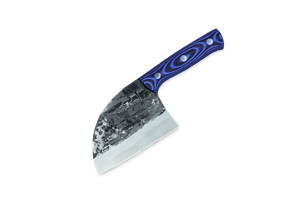
Kitchen knife sets make sense when you are replacing an entire drawer, setting up a first serious kitchen, or buying a practical gift. The better sets are coherent: each knife has a defined job and uses materials and handles that feel consistent. Avoid sets padded with duplicates, oversized cleavers you will never use, or decorative pieces that do not improve your prep.
Steel, Edge, and Handle: The Details You Feel
Blade steel determines a knife’s potential, not its final performance. Harder steel can support a thinner, keener edge and often stays sharp longer. The trade-off is that a very hard edge can be less forgiving if it hits bone, a plate, or a hard countertop. Softer stainless steel generally requires more frequent sharpening but may be more resilient during rougher use.
For most home cooks, stainless or stainless-clad blades offer the most practical balance. They resist staining and corrosion while delivering serious sharpness with normal maintenance. High-carbon blades can develop a natural patina and reward attentive users with excellent cutting feedback, but they need prompt drying and more deliberate care.
Handle choice is personal. A rounded handle may favor a pinch grip and fluid transitions. A more angular handle can offer a stronger index point for some users. What matters is that the knife sits securely in your hand without forcing your wrist into an awkward angle. If a handle feels slippery, overly bulky, or top-heavy before you start cutting, it will become more frustrating during a long prep session.
Sharpness Is a Maintenance Habit
Even the best professional kitchen knives become dull. That is normal. The difference is how you maintain them.
Honing and sharpening are not the same task. Honing realigns a slightly rolled edge and can help restore clean cutting between sharpenings. Sharpening removes a small amount of metal to create a new edge. If your knife slides off a tomato skin, tears herbs, or needs pressure to cut an onion, it likely needs sharpening rather than another pass on a honing rod.
Sharpening stones give the most control and can produce a refined edge, but they require practice to maintain a consistent angle. Manual and guided knife sharpeners are faster and more approachable for regular maintenance, although some remove more material than a careful stone session. Match the tool to your confidence and the blade’s intended edge angle.
Use a wood or quality synthetic cutting board. Glass, marble, ceramic plates, and bare countertops can damage a sharp edge quickly. Hand-wash your knives, dry them immediately, and store them where the edges cannot collide. A knife block, blade guards, drawer organizer, or magnetic holder keeps sharp tools protected and ready.
Choose for Your Cooking, Not Someone Else’s
A professional knife should make you want to prep dinner, not make you adjust your technique around it. If you cook mostly vegetables, a Santoku or Nakiri may become your first-choice blade. If you tackle mixed meals and larger proteins, an 8-inch chef knife is difficult to beat. If you bake sourdough or buy crusty bread, a serious serrated knife is not optional.
Build slowly, pay attention to the cuts you make most often, and keep the edge maintained. The right knife does not need to look delicate to cut with precision. It needs to feel certain in your hand every time it meets the board.


Leave a comment