BLACK NOVEMBER −30% on all knives Only in November · no code · until 30 November · Free EU shipping from €79Shop the knives
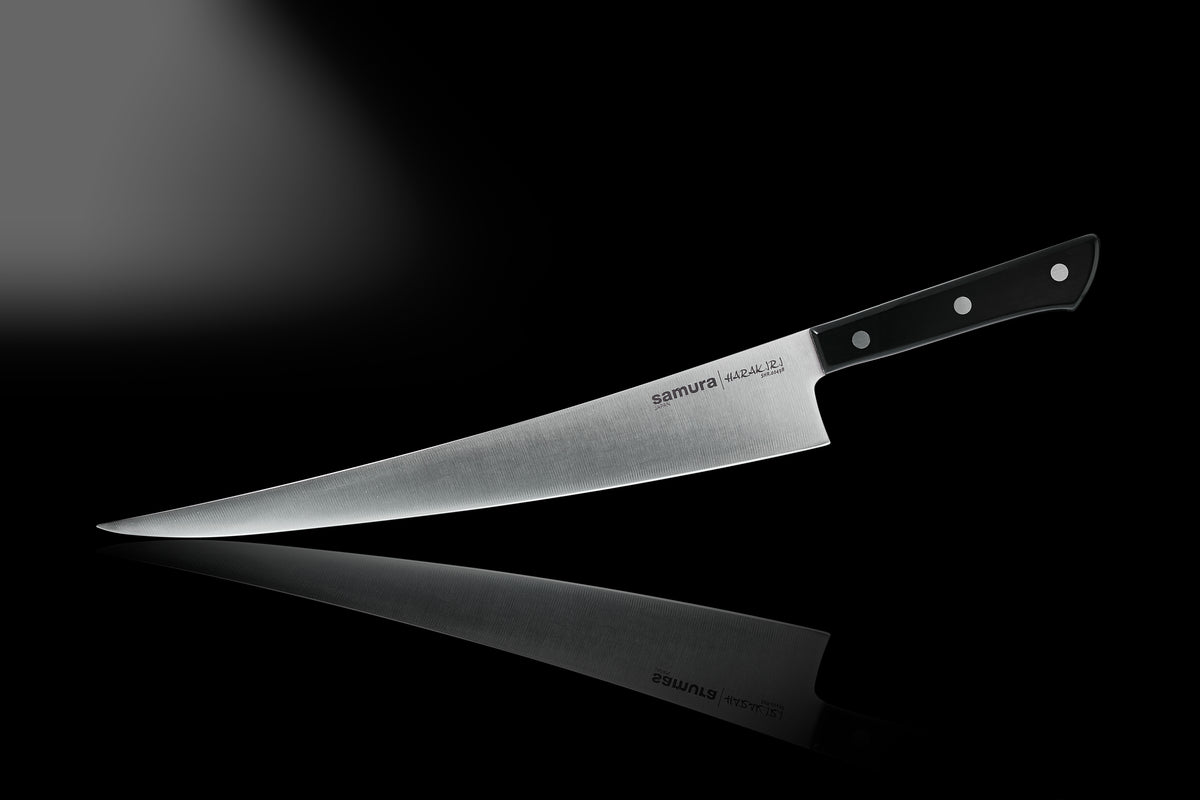
SAMURA Harakiri long slicer and its reflection on black

A SAMURA story

The edge

Everything a knife does happens along one thin line. This is how that line is made, measured and kept.

SAMURA Damascus 67 chef's knife on black, its layers visible

01 / 05

It starts with the steel

Most SAMURA series use AUS-8 stainless steel, a single solid layer, so the steel on the flanks is the same steel that forms the edge. AUS-10 adds carbon and reaches a higher hardness. VG-10 is a high-carbon stainless steel valued for a fine, long-lasting edge.

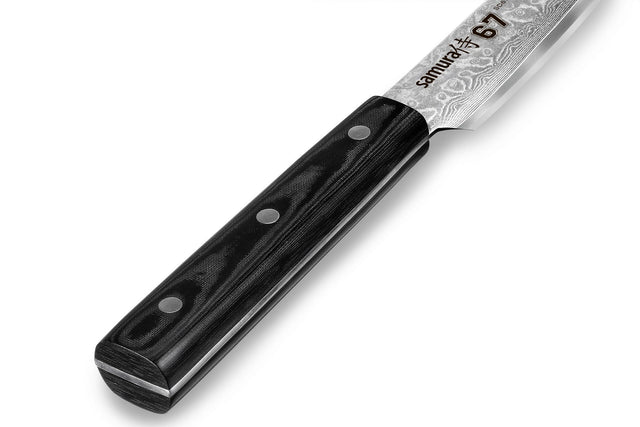
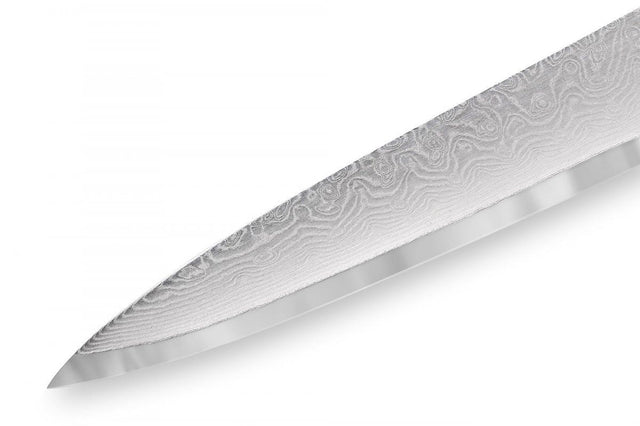
In a Damascus blade, layers of steel are forge-welded together. The pattern is visual: how the knife cuts depends on the steel at the edge, its hardness and the blade geometry.

1
Solid AUS-8 and AUS-10 blades
5
Artefact, Meteora and Super 5
67
Damascus, Damascus 67, Pro-S Lunar and Sultan
Read the steel guide
SAMURA Sultan long slicer on black

02 / 05

Then it is measured

Hardness is given in HRC. At 58–59 HRC, AUS-8 is forgiving: the edge is more likely to roll than chip. Higher up the scale, a thin edge stays keen for longer, and it asks for clean, controlled cuts.

SAMURA Bamboo cleaver on black

03 / 05

The angle sets the geometry

Where SAMURA lists a sharpening angle, it is one of two values in the catalogue. Whichever you sharpen, keep the angle the same on both sides.

16–18°

Listed for Damascus knives.

The angle sets the geometry
SAMURA Damascus bread knife with a serrated edge on black

04 / 05

The shape follows the job

Most SAMURA edges are double-bevel. The others exist for a reason.

Double-bevel
Ground at an angle on both sides, for either hand.
Convex
Curves gently into the cutting line, which adds support behind the edge.
Single-bevel
On the yanagiba, a Japanese-style slicer for raw fish and sashimi.
Serrated
Bites through hard crust without crushing the soft crumb.
Browse the knife guide
Hands honing a SAMURA knife on a ceramic rod

05 / 05

Then it is kept

A few light strokes on a honing rod between sharpenings keep the edge aligned. When slices start to tear, use a medium-grit whetstone to set the edge, then a fine grit to refine it.

Wash by hand, dry straight away and cut on wood or plastic, not glass or stone. Ceramic blades need a diamond abrasive or a professional service.

240
Grit: the coarsest stone listed
8000
Grit: the finest
Shop sharpening tools

67 layers, 60–61 HRC

Damascus 67

Samura Damascus 67 Chef's Knife 208 mm – main view BLACK NOVEMBER −30%

Damascus · 60–61 HRC · 208 mm

Damascus 67 Chef's Knife 208 mm

€91,99€64,40 with BLACK NOVEMBER

Samura Damascus 67 Slicing Knife Tanto 230 mm – main view BLACK NOVEMBER −30%

Damascus · 60–61 HRC · 230 mm

Damascus 67 Slicing Knife Tanto 230 mm

€122,99€86,10 with BLACK NOVEMBER

Samura Damascus 67 Grand Chef's Knife 240 mm – main view BLACK NOVEMBER −30%

Damascus · 60–61 HRC · 240 mm

Damascus 67 Grand Chef's Knife 240 mm

€124,99€87,50 with BLACK NOVEMBER

Samura Damascus 67 Slicing Knife 195 mm – main view BLACK NOVEMBER −30%

Damascus · 60–61 HRC · 195 mm

Damascus 67 Slicing Knife 195 mm

€71,99€50,40 with BLACK NOVEMBER

Find the edge that fits your kitchen.