Sharpening tools
Keep your kitchen knives in working order with Samura sharpening tools. The collection covers single and combination whetstones from #240 to #8000 grit, a #360/#600 diamond combination stone and the diamond sharpening block for the SEC-2000 electric diamond knife sharpener. A ceramic honing rod helps you adjust the cutting edge between sharpenings, and an angle holder with ceramic guides supports your work on the stone.
Each stone has its job. Coarse grits such as #240/#800 and #400 correct the blade angle, #1000 starts a sharpening session and handles light resharpening, and #5000 and #8000 finish and polish the edge, the #8000 up to a mirror-like finish. Combination stones put two grits on one stone, so you can move from coarser to finer without changing stones. Soak the whetstones in water for 10–15 minutes before use, keep them wet while you work and hold the factory bevel angle of 15–17°.
New to sharpening? Our step-by-step guide on how to sharpen kitchen knives walks you through the process, the whetstone grit guide helps you choose a stone, and honing rod vs sharpener explains which tool your knife needs.
Knife guide
Sharpening tools, explained
Whetstones, a diamond stone, a ceramic honing rod and an angle holder each do a different job. Here is which tool to reach for, which grit comes next and how to hold a steady angle.
All models in stock, compared
| Model | Blade steel | Hardness | Blade | Handle | Price |
|---|---|---|---|---|---|
| Samura Sharpening Angle Holder with Ceramic Guides | €9,99 | ||||
| Samura Whetstone, #400 | €24,99 | ||||
| Samura Whetstone, #1000 | €24,99 | ||||
| Replacement block for electric sharpener SEC-2000 with diamond blades. | €27,99 | ||||
| Samura Whetstone, #2000 | €29,99 | ||||
| Samura Whetstone, #5000 | €35,99 | ||||
| Samura Whetstone, #8000 | €37,99 | ||||
| Samura Combination Whetstone, #240/#800 | €37,99 | ||||
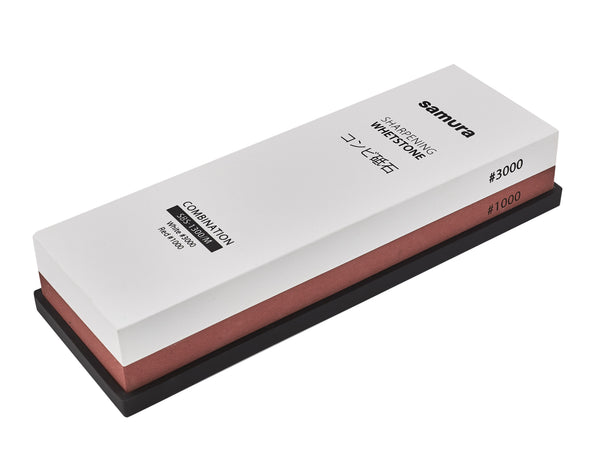
| Samura Combination Whetstone, #1000/#3000, 185 × 65 × 32 mm | €49,99 | ||||
| Samura Combination Whetstone, #2000/#5000 | €52,99 | ||||
| Samura Diamond Combination Stone, #360/#600 | €57,99 | ||||
| Samura Combination Whetstone, #3000/#8000 | €63,99 | ||||
| Samura Combination Whetstone, #1000/#3000, 240 × 80 × 40 mm | €105,99 |
How to choose
Four steps to the right whetstone
-
Check your steel
Compare the steelsAUS-8 knives sharpen well on a #1000/#3000 stone. For AUS-10, VG-10 and Damascus add a #8000 stone for a finer finish. Ceramic blades need a diamond stone.
-
Choose the grit
#240–#400 repairs chips and a damaged edge, #1000 restores a dull edge, #2000–#3000 refines it and #5000–#8000 polishes it.
-
Choose your tool
A whetstone gives the most control, a combination stone gives you two grits in one, an electric sharpener is the quickest and a honing rod keeps the edge between sharpenings.
-
Keep the angle steady
A steady angle matters more than force. An angle holder helps beginners keep the blade at the same angle on every stroke.
Why choose SAMURA
Four reasons to choose SAMURA
-
Ultra-sharp from the first cut
Steel guideJapanese-grade AUS-8, AUS-10, VG-10 and Damascus steels, hardened to 58–61 HRC and sharpened to a razor-sharp, precise edge.
-
Premium quality, fair price
All seriesThe steel, finish and design of high-end Japanese-style knives without the luxury mark-up: a premium knife you can use every day.
-
Packaged to be given
Premium SAMURA packaging makes every knife and set a ready-made gift for anyone who loves to cook.
-
Build your own collection
Every series offers matching knives for every task. Complete one series or combine your favourites across collections.

Questions
Sharpening questions
Did not find the answer? Write to us and we will help you choose.
Contact usDo I need to soak a whetstone before sharpening?
Yes. Submerge SAMURA whetstones completely in water for 10–15 minutes before use and keep them wet the whole time you sharpen.
What angle should I sharpen at?
Keep the original factory angle of your knife. The instructions for SAMURA whetstones and the honing rod give a factory bevel angle of 15–17°. The angle holder helps you hold it on every stroke.
How do I sharpen a single-bevel Japanese-style knife?
Sharpen the bevelled side until a uniform burr appears, then pass the flat side lightly over the stone a few times. Double-bevel knives are sharpened one side at a time until a burr appears.
When should I use the diamond stone?
Use it for rough work: removing flaws that have appeared on a blade over time and restoring the edge angle of a worn knife. Start on the #360 side, turn to #600, then continue on a finer whetstone.
Which stone suits a beginner?
The #1000/#3000 combination stone is easy to use even if you have never sharpened on a whetstone. The #1000 side sharpens and the #3000 side finishes, so both steps happen on one stone.
How do I test whether the edge is sharp?
Never with bare hands. Slice a piece of paper instead.
Which whetstone grit do I need?
Use #1000 to restore the edge and #3000 to refine it. A #8000 stone polishes harder steels such as AUS-10, VG-10 and Damascus. Ceramic blades need a diamond stone.
How often should I sharpen my knife?
When it stops slicing cleanly: if it slips on a tomato skin or crushes herbs instead of cutting them, it is time. Regular light sharpening keeps the edge in better shape than rare heavy sharpening.
What is the difference between sharpening and honing?
Sharpening removes a little steel to form a new edge, usually on a whetstone. Honing with a rod realigns the edge between sharpenings and removes very little.
Whetstone or electric sharpener?
A whetstone gives more control and a finer edge. An electric sharpener is quicker and needs no practice, which suits everyday knives.
Can I sharpen serrated knives on a whetstone?
No. Flat whetstones do not sharpen serrations.
What guarantee do SAMURA knives have?
Every product comes with the 2-year legal guarantee.
Can I return a knife?
Yes. You can return an order within 14 days – see the return policy for the conditions.
How should I care for my knife?
Wash by hand and dry straight away. Each product page lists the care instructions for that knife.