

A Santoku knife for vegetables earns its place by making repetitive prep feel controlled rather than tedious. A sharp, wide blade moves cleanly through onions, peppers, cabbage, squash, and herbs, while its compact profile gives the cook close contact with the board. It is a serious everyday tool, not a specialty knife that sits unused between dinner parties.
The key is knowing what a Santoku does best. It excels at precise slicing, dicing, and chopping with a forward-and-down motion. It is less suited to jobs that demand force, deep rocking, or cutting through bone. Choose it for the vegetables you prep most often, and it can become the true workhorse of your kitchen.
Why a Santoku knife for vegetables works so well
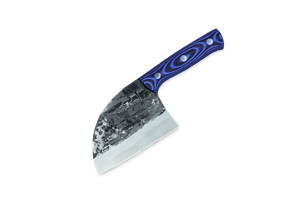
A Santoku typically has a blade around 5 to 7 inches long, a relatively flat cutting edge, and a broad blade face. Those details change the way it handles produce. The shorter blade feels nimble around smaller ingredients, while the generous blade height gives your knuckles clearance and creates a useful surface for moving chopped food from board to pan.
The tip is often a rounded, downward-curving sheep’s-foot shape rather than the pointed tip found on many chef’s knives. That design favors controlled straight cuts. When you are turning a pile of carrots into neat coins or cutting cucumber into thin half-moons, the blade stays stable and predictable.
A good Santoku also reduces damage to delicate produce. An ultra-sharp edge separates cells cleanly instead of crushing them. Herbs keep more of their color, ripe tomatoes release less juice, and onions are easier to dice without turning into ragged layers. Sharpness does not replace technique, but it makes good technique easier to repeat.
Some Santoku blades include hollow-edge indentations. These can reduce sticking when slicing potatoes, zucchini, or dense squash, but they are not magic. Moist ingredients can still cling to any blade. Blade finish, edge sharpness, and a confident cutting motion matter just as much.
The Santoku versus chef knife decision
A Santoku and a chef knife overlap heavily. Both can handle daily vegetable prep, fruit, herbs, and boneless proteins. The choice comes down to movement, size, and how the knife feels in your hand.
A Santoku favors push cutting and chopping. Keep the edge close to the board, move it forward slightly, then cut down. Its flatter edge supports full contact with the cutting board, which is useful when making uniform dice. Many home cooks also prefer its shorter length because it feels less intimidating and more responsive in a compact kitchen.
A classic chef knife has more curve along the belly, a pointed tip, and commonly a longer 8-inch blade. It is the more flexible choice if you use a rocking motion, break down larger produce, or want one blade for a wider range of tasks. For a large butternut squash, a big head of cabbage, or a family-size pile of onions, the extra length and leverage can be an advantage.
Neither shape is automatically better. If you naturally rock the blade from tip to heel, a chef knife will feel more familiar. If you prefer a direct, vertical cut and value a compact blade, a Santoku is likely the stronger fit. Many well-equipped kitchens keep both because they solve slightly different problems.
What vegetables can a Santoku handle?
A Santoku is built for most day-to-day vegetable work. It slices bell peppers without tearing the skin, cuts celery and carrots with clean control, shreds cabbage, dices onions, and turns piles of herbs into a fine chop. Its broad blade is particularly useful for transferring ingredients after prep, though use the spine, not the sharp edge, when scraping food across the board.
For firm produce, let the sharp edge do the work. Cut a potato, sweet potato, or winter squash in controlled stages instead of trying to force the entire blade through at once. First create a stable flat side. Then use a deliberate forward-and-down push cut. If an ingredient is unusually hard or oversized, a larger chef knife or a heavier cleaver-style tool may be safer.
There are limits. Do not use a Santoku to split bones, pry apart frozen food, crack nuts, or strike hard pits. Those tasks can chip a fine edge or damage the blade. A Santoku is made to cut, not to act as a wedge, screwdriver, or butcher’s tool.
Santoku or Nakiri for vegetable-heavy cooking?
If vegetables dominate nearly every meal, a Nakiri is worth considering. Its rectangular blade is designed specifically for board work, with a very flat edge that makes full-length chopping efficient. It is excellent for large volumes of greens, cabbage, root vegetables, and fine julienne work.
A Santoku is more versatile. The pointed front section, even though it is rounded compared with a chef knife, is more useful for detail work around peppers, trimming produce, and handling boneless proteins. Think of the Nakiri as the vegetable specialist and the Santoku as the all-around Japanese-inspired prep knife. For one high-performance blade in a home kitchen, the Santoku often makes more sense.
Choose the right blade length, edge, and handle
For most home cooks, a 6- to 7-inch Santoku offers the best balance. It has enough blade length for onions, zucchini, and medium cabbage while staying quick around smaller ingredients. A 5-inch version suits cooks with smaller hands, tight counter space, or light prep needs. A 7-inch blade is better for those who regularly cook for several people and want more reach.
Pay attention to blade geometry, not just appearance. A thin, sharp blade passes through vegetables with less resistance and produces cleaner slices. It also requires more thoughtful use than a thick, heavy blade. Avoid twisting it inside hard foods and use a stable board. A fine cutting edge rewards control.
Handle comfort matters just as much as the steel. Your grip should feel secure without forcing your wrist into an awkward angle. Hold the knife as you would during prep, ideally with a pinch grip near the blade for maximum control. A handle that looks dramatic but feels slippery or oversized will become a problem halfway through a weeknight meal.
SAMURA Santoku knives are designed around this balance of Japanese-inspired geometry, modern materials, and powerful cutting performance. The right choice should feel planted in the hand while staying fast through a full board of vegetables.
Use proper Santoku cutting technique
Start with a stable cutting board. Wood and quality composite boards are kinder to a sharp edge than glass, marble, ceramic, or bare stone. Those hard surfaces can dull a knife quickly and make cutting less secure.
Use a claw grip with your guide hand: curl your fingertips inward and let the side of the blade rest lightly against your knuckles as you cut. Keep the blade nearly vertical and make a forward-and-down motion. Lift only enough to clear the food, then repeat. This gives the Santoku’s flatter profile the contact it needs.
Avoid aggressive rocking. A small amount of motion is fine, but a Santoku does not have the deep curved belly that makes a chef knife excel at full rocking cuts. Pressing and rocking hard can leave uncut sections or cause the edge to strike the board at an inefficient angle.
For herbs, gather them into a compact pile and use short, controlled chops. If you need a very fine mince, turn the pile and repeat rather than grinding the blade back and forth across the board. That protects the edge and produces a cleaner result.
Keep a Santoku sharp enough for vegetables
Vegetable prep exposes a knife to frequent board contact, so maintenance is part of performance. Hand-wash the blade soon after use with mild soap, rinse it, and dry it completely. A dishwasher can expose the knife to harsh detergent, heat, moisture, and collisions with other utensils. None of that helps a sharp edge stay sharp.
Store the knife where the edge cannot strike other metal tools. A knife block, magnetic holder, blade guard, or protected drawer organizer is far better than tossing it loose into a drawer.
When the blade begins to slide on tomato skin, crush herbs, or require extra pressure through an onion, it is time for attention. Honing can realign a slightly rolled edge, while sharpening removes metal to create a new cutting bevel. Use an appropriate sharpener or sharpening stone for the blade steel and follow the intended angle. Regular light maintenance is easier on the knife than waiting until it is completely dull.
A Santoku is at its best when it feels like an extension of your hand: sharp, stable, and ready for the next onion, pepper, or handful of herbs. Choose the size that matches your prep, protect the edge, and let the blade do the hard work.


Leave a comment