

A japanese chef knife earns its place the first time it moves through an onion without crushing it, portions a chicken with control, or turns a pile of herbs into clean, even cuts. This is not kitchen decoration. It is performance equipment: thinner behind the edge, more precise at the tip, and built to make everyday prep feel faster and more deliberate.
For home cooks, grillers, and serious food lovers, the appeal is simple. A well-chosen Japanese-style blade gives you more control over the food in front of you. But the category is broad. Blade shape, steel, grind, handle, and maintenance all affect how a knife feels and where it performs best.
What Makes a Japanese Chef Knife Different?
The classic Western chef knife is designed as an all-purpose workhorse, often with a broad blade and pronounced curve for rocking through food. A Japanese chef knife, often called a gyuto, also covers a huge range of daily tasks, but it typically brings a thinner blade, a finer edge, and a flatter cutting profile.
That geometry matters. A thin edge parts vegetables and boneless proteins with less resistance, helping preserve clean surfaces instead of splitting or tearing them. The flatter profile supports push cuts, pull cuts, and controlled chopping. You can still rock a gyuto to a degree, but it is not the right tool for aggressive, high-impact rocking on a hard board.
Many Japanese-style knives are also ground thinner behind the cutting edge. That is where the knife does its real work. The steel may be beautiful, especially in layered Damascus patterns, but geometry is what determines whether a blade glides through a ripe tomato or wedges in a potato.
The trade-off is clear: thin, hard edges reward good technique and proper care. They are not built for frozen food, thick bones, glass cutting boards, or twisting through joints. Use the right knife for the job, and that precision becomes a serious advantage.
Choose the Blade Shape for How You Cook
A gyuto is the closest match to a Western chef knife and the strongest first choice for most kitchens. An 8-inch blade offers an excellent balance of reach, control, and board space. It can handle onions, cabbage, garlic, steaks, boneless chicken, and larger vegetables without feeling oversized. A 6-inch gyuto suits smaller hands, tighter kitchens, and lighter prep. A 9-inch version gives experienced cooks more speed when working with volume.
The santoku is another powerful everyday option. Its shorter, wider blade and flatter edge make it especially capable with vegetables, fish, and boneless meat. It feels quick and planted on the board. If your cooking leans toward slicing, dicing, and push-cutting rather than rocking, a santoku can be a true workhorse.
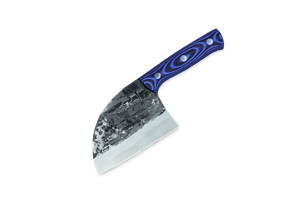
Specialized shapes are worth adding when your cooking demands them. A nakiri gives vegetables a flat, confident cutting edge and tall blade clearance. A yanagiba is made for long, clean slices of raw fish. A deba brings thicker, stronger construction for breaking down fish, though it requires technique and should not be treated like a bone cleaver. For large cuts, dense squash, or heavy barbecue prep, a hand-forged cleaver offers brutal character and serious cutting power.
Do not buy a specialized blade simply because it looks impressive. Start with the knife that will see daily use. Add purpose-built tools when they solve a real problem in your prep routine.
Steel: Edge Holding Versus Easy Maintenance
Steel choice sets the rhythm of knife ownership. Stainless steel is the practical choice for cooks who want strong sharpness with low maintenance. It resists corrosion, handles busy weekday cooking well, and asks little more than washing, drying, and regular honing or sharpening.
High-carbon steel can take an exceptionally fine edge and develops a distinct patina over time. It has a workshop-built feel that many knife enthusiasts love. But carbon steel demands discipline. Leave it wet after slicing citrus, tomatoes, or onions, and it can stain or rust. Wipe it dry immediately, wash by hand, and store it in a dry place.
Damascus construction adds visual depth through layered steel, but it should never be the only reason to choose a knife. A Damascus blade should also have a quality core steel, consistent heat treatment, and a grind that cuts cleanly. The pattern is the signature. The edge is the engine.
Harder steel usually holds a sharper edge longer, but it can be more prone to chipping if abused. Softer stainless steel may need sharpening sooner, yet it tends to be more forgiving. There is no universal winner. The right balance depends on whether you want maximum edge retention, easy maintenance, or a blade that can take a little more rough treatment.
The Handle Must Work Under Pressure
A knife can have an ultra-sharp core and still feel wrong if the handle does not suit your grip. Western-style handles are familiar, contoured, and often feel secure to cooks moving from traditional European knives. Japanese-style handles are commonly lighter and more angular, shifting the balance toward the blade for nimble, controlled cuts.
Wood handles bring warmth, texture, and visual craft, but they should be hand-washed and dried promptly. Durable synthetic handles are practical for high-frequency cooking and easier care. Neither option is automatically better. Hold the knife if possible, or consider your usual grip and the size of your hands before choosing.
Balance also matters. A forward-balanced blade can feel lively during slicing and vegetable work. A more neutral balance may feel steadier for all-purpose prep. The best knife is not the heaviest or the flashiest. It is the one you can guide accurately after twenty minutes at the cutting board.
Keep the Edge Sharp, Not Just Shiny
A sharp knife is safer because it cuts where you direct it. A dull blade slips, crushes food, and forces unnecessary pressure. Yet many good knives lose their edge early because they are maintained with the wrong tools.
A honing rod realigns a slightly rolled edge on softer steel, but it does not replace sharpening. Very hard Japanese-style edges often benefit more from careful whetstone sharpening than repeated use of a coarse pull-through sharpener. A whetstone removes steel in a controlled way and restores the bevel rather than scraping it away indiscriminately.
For daily care, wash your knife by hand with mild soap, dry it immediately, and never leave it soaking in the sink. Avoid the dishwasher. Heat, detergent, impact, and loose contact with other utensils are hard on both edge and handle. Use a wood or quality plastic cutting board, not glass, marble, ceramic, or a plate.
Store the blade where it cannot strike other metal. A magnetic holder, knife block, blade guard, or dedicated stand protects the edge and keeps a serious tool ready for the next meal.
Build a Knife Setup That Makes Sense
One excellent chef knife is more valuable than a drawer full of weak, mismatched blades. For most home kitchens, start with a gyuto or santoku, then add a small utility or paring knife for detail work. If you bake, a serrated bread knife is essential. If you regularly cook fish, break down poultry, or grill large cuts, choose a specialized blade when the need appears.
SAMURA builds this kind of progression into its knife range, from practical stainless workhorses to layered Damascus blades and hand-forged heavy hitters. The point is not to own every profile. It is to choose equipment that matches the way you cook and maintain it with the same intent.
A Japanese-style knife rewards respect, but not ceremony. Put it on a proper board, keep the edge tuned, and use it with control. Soon, the clean cuts, better pace, and confidence at the counter will make it the blade you reach for first.


Leave a comment