

A tomato crushed under a dull blade, an onion that slides away from the edge, a roast hacked into uneven pieces - these are not cooking problems. They are knife problems. The right cooking knives turn prep from a slow fight into controlled, precise work. They should feel planted in your hand, bite cleanly into food, and keep performing long after the first impressive cut.
A good kitchen does not need a drawer packed with random blades. It needs a compact lineup chosen for the way you cook: a true workhorse for daily prep, a few specialists for the jobs that demand them, and a sharpening routine that protects the edge you paid for.
Cooking Knives Start With the Work
Start with what reaches your cutting board most often. If you cook weeknight meals, chop vegetables, trim chicken, and portion fruit, a chef knife is the center of the operation. Its curved edge supports a rocking motion, while the pointed tip handles detailed work. An 8-inch blade gives most home cooks enough reach for cabbage, squash, and larger proteins without becoming cumbersome.
A santoku offers a different kind of control. Its flatter edge favors clean up-and-down chopping, and its shorter, often wider blade moves quickly through vegetables, boneless meat, and herbs. For cooks who prefer a compact, nimble feel, it can be the knife they reach for first. It is less ideal than a chef knife for aggressive rocking cuts, so blade choice depends on technique as much as ingredients.
Then there is the utility knife: the sharp middle ground between a chef knife and a paring knife. It is useful for sandwiches, smaller produce, citrus, and jobs where a full-size blade feels excessive. A paring knife handles peeling, coring, trimming, and any cut made in the hand rather than on the board. Small blade, serious control.
Specialty knives earn their space when the food demands it. A bread knife's serrated edge grips a crust without flattening a warm loaf. A slicing knife creates long, clean strokes through brisket, ham, or roast turkey. A flexible fillet knife follows the contour of fish with less waste. A deba brings weight and authority to fish breakdown, while a yanagiba is built for the long, disciplined slices used for raw fish.
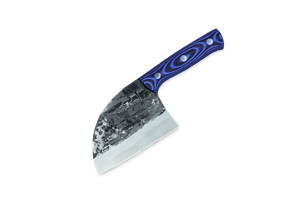
A cleaver is not one thing. A thin vegetable cleaver can be fast and precise, using its broad blade to transfer chopped ingredients. A heavy Serbian-style or butcher cleaver brings brute force for larger cuts, dense squash, and serious meat work. Neither should be treated as a substitute for a bone saw. Even a powerful blade has limits, and striking hard bone or frozen food can chip an ultra-sharp edge.
Steel, Edge, and Handle: What You Actually Feel
Marketing language can make every steel sound invincible. In real kitchen use, the meaningful question is simpler: how does the blade balance sharpness, edge retention, toughness, corrosion resistance, and maintenance?
Stainless steel is the practical workhorse. It resists staining and is forgiving when dinner gets busy and cleanup is not immediate. Quality stainless blades can take a very fine edge and serve daily cooks well, especially when paired with regular honing and occasional sharpening.
Carbon steel delivers a different character. It can take an exceptionally keen edge and develops a dark patina with use. That living finish is part of its appeal, but carbon steel asks for discipline. Wash it by hand, dry it immediately, and never leave it wet beside acidic food. For a cook who enjoys caring for equipment, that exchange can be worth it. For someone who wants zero-fuss cleanup, stainless is usually the smarter call.
Damascus construction adds visual depth, but the performance comes from the steel selection, heat treatment, geometry, and the quality of the cutting core. A layered blade can be striking, but its pattern alone does not make it sharp. Look for a thin, well-ground edge that passes through food rather than splitting it apart.
Ceramic knives are another useful tool, especially for fruit, vegetables, and boneless proteins. They stay sharp for a long time and will not rust, but they are brittle compared with steel. Do not twist them in hard food, drop them in the sink, or use them near bone. Think precision cutter, not all-purpose weapon.
Handle shape matters more than a quick grip in a showroom. A knife should feel secure when your hands are wet, not force you to squeeze hard, and balance near the pinch grip - where thumb and forefinger meet the blade. Wood handles bring warmth and workshop character, but need hand washing and sensible care. Modern composite and stainless handles are often more resistant to moisture and easier to maintain. Neither is automatically better; the best handle is the one that keeps you relaxed and in control through a full prep session.
Build a Lean, Hard-Working Knife Kit
For most kitchens, the best first upgrade is not a giant block set. Buy the blades that solve real problems. A strong three-knife foundation is an 8-inch chef knife or santoku, a paring knife, and a serrated bread knife. Add a slicing knife if you roast, grill, or smoke meat regularly. Add a fillet knife if fish is a recurring part of your menu.
A set makes sense when you are equipping a new kitchen, replacing a drawer of mismatched blades, or buying a gift for someone who cooks often. The advantage is consistency: matching steel, handles, edge feel, and storage. The trade-off is that some sets include blades that may see little use. Judge a set by the knives you will use every week, not by the largest piece count.
For cooks drawn to bold, hand-forged character, a heavy cleaver or dark-finished carbon blade can become the most satisfying tool in the kitchen. For high-volume family cooking, a tough stainless chef knife is often the better true workhorse. SAMURA’s range makes room for both approaches, from practical stainless blades to Damascus and workshop-inspired forged profiles.
Sharpness Is a Maintenance Habit
A knife does not become dull only because the steel is poor. The edge gradually folds, wears, and loses its clean line through normal contact with food and cutting boards. Honing and sharpening solve different problems.
A honing rod realigns a slightly rolled edge. Use it lightly and regularly, especially on stainless knives that see frequent work. Sharpening removes a small amount of metal to create a new edge. That is the job for a whetstone, guided sharpener, or a professional sharpening service. If a knife slips on tomato skin or tears herbs instead of slicing them, it is time to sharpen.
Whetstones give the most control and can produce a frighteningly sharp edge, but they take patience. Maintain a consistent angle, work both sides evenly, and let the stone do the cutting. Pull-through sharpeners are faster and convenient, though aggressive models can remove more steel than necessary. Choose the method you will actually use correctly.
Never toss knives loose into a drawer. Edge-on-edge contact ruins sharpness and creates a safety hazard when you reach in. A magnetic holder, knife block, blade guards, or a dedicated drawer insert protects both the blade and your fingers. Use wood or quality plastic cutting boards, not glass, marble, ceramic plates, or bare countertops. Hard surfaces punish edges fast.
Hand wash quality knives with mild soap, dry them right away, and keep them out of the dishwasher. Heat, detergent, moisture, and collision with other utensils are a brutal combination for steel edges and handles. A few seconds of care after cooking can preserve a blade for years.
Let the Blade Do the Work
The sharpest kitchen looks less dramatic than people expect. There is no excessive force, no sawing through soft produce, and no pile of crushed herbs. There is a stable board, a controlled grip, and the right blade moving with purpose.
Choose cooking knives for the meals you make, maintain them before they become frustrating, and give each blade a job it can dominate. The next time an onion hits the board, the difference will be immediate.


Leave a comment