

A drawer full of dull, random knives turns dinner into a fight. The best knives for home cooks are not the biggest set or the flashiest block on the counter. They are a small, hard-working lineup with sharp edges, confident balance, and a clear job in your hands - from breaking down a chicken to slicing a tomato without crushing it.
A good knife should make prep feel faster and more controlled. It should not force you to saw through onions, lean your weight into squash, or reach for a second blade because the first one cannot handle the task. Buy for the food you actually cook, then choose construction that matches how much maintenance you are willing to do.
Start With Three Knives, Not Fifteen
For most kitchens, a chef knife, a paring knife, and a serrated bread knife cover the daily work. This is the foundation that earns its counter space. Add specialized blades only when your cooking habits demand them.
The chef knife: the true workhorse
An 8-inch chef knife is the command center of a home kitchen. It handles onions, herbs, carrots, cabbage, boneless meat, garlic, and nearly every other repetitive prep task. Its curved cutting edge supports a natural rocking motion, while its broad blade helps move chopped ingredients from board to pan.
A 6-inch chef knife can be the smarter choice for smaller hands, tight kitchens, or cooks who prefer a lighter, quicker feel. A 10-inch model brings more reach for big melons, large cuts of meat, and high-volume prep, but it can feel unwieldy if you cook for two. The right length is the one you can guide precisely without overreaching.
Look for a blade with enough height to keep your knuckles off the board and enough weight to feel stable, not sluggish. A full-sized chef knife should be a tool you want to grab every night, not an impressive object you avoid using.
The paring knife: control at close range
A 3- to 4-inch paring knife handles jobs that are too delicate or too awkward for a chef knife: peeling apples, trimming strawberries, removing pepper seeds, segmenting citrus, and cutting small garnishes. It is inexpensive compared with larger knives, yet it earns its place constantly.
Keep it sharp. A paring knife is often used in the hand rather than against a cutting board, so a clean edge matters for both control and safety.
The serrated knife: protect soft food and crusty bread
A serrated bread knife cuts through crackling loaves, ripe tomatoes, citrus, layer cakes, and soft fruit with minimal pressure. Its teeth grip surfaces that a straight edge may skid across. Choose a blade long enough to cross a loaf in one smooth pull rather than a series of ragged sawing motions.
Serrated edges are harder to sharpen at home than straight edges. That trade-off is worth it, but choose a well-made knife and avoid treating it like a utility saw on frozen food or bones.
Best Knives for Home Cooks Who Want More Range
Once the core three are handled, specialization becomes useful rather than clutter. The key is to buy a knife because it solves a real prep problem, not because it looks dangerous in a product photo.
A santoku is an excellent alternative or companion to a chef knife. Its flatter edge favors clean up-and-down chopping, especially for vegetables, herbs, and boneless proteins. The wide blade also makes quick work of transferring ingredients. If you rarely use a rocking motion and prefer a compact, agile profile, a 6- or 7-inch santoku can become your daily driver.
A utility knife, usually around 5 inches, fills the space between paring and chef knives. It is handy for sandwiches, small tomatoes, cheese, and trimming modest cuts of meat. It is not essential for every cook, but it can be the most-reached-for blade in a household where a full chef knife feels oversized.
For people who cook meat often, a boning knife brings control around joints, ribs, and fat seams. Its narrow blade reaches where a chef knife cannot. A flexible version is useful for fish; a stiffer blade is better for poultry, pork, and beef. Do not use it to chop through bone. Thin blades are built for precision, not brute force.
A carving or slicing knife matters when roasts, brisket, turkey, smoked meats, or large fish are part of the menu. A long, narrow blade creates clean slices with fewer strokes, keeping juices in the meat instead of tearing the surface. Grillers will feel the difference immediately when a rested steak or tri-tip hits the board.
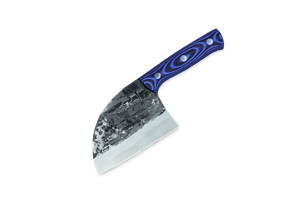
Cleavers deserve a more careful decision. A heavy Chinese-style vegetable cleaver can be superb for chopping and scooping produce, while a thick, hand-forged Serbian-style cleaver brings powerful cutting performance to dense ingredients and substantial meat prep. Neither is automatically a bone chopper. Read the intended use of the blade, because edge geometry matters more than its intimidating silhouette.
Choose Steel for the Way You Actually Live
Steel determines how long a knife stays sharp, how easily it sharpens, how much abuse it tolerates, and how much care it asks from you. There is no single winner.
Stainless steel is the practical workhorse for most home cooks. It resists staining and corrosion, handles busy weeknights well, and requires less vigilance around wet sinks and acidic ingredients. A quality stainless blade can still take a very fine edge. For a first serious knife, this is often the right call.
High-carbon steel typically offers exceptional sharpness and a responsive sharpening feel. It can develop a patina over time and may rust if left wet, so it rewards a cook who washes, dries, and stores tools with discipline. That evolving finish is part of the appeal for some owners and a dealbreaker for others.
Damascus-patterned blades bring layered visual character and, depending on the construction, can combine a hard cutting core with protective outer layers. The pattern alone does not guarantee performance. Check the blade’s edge, profile, fit, and overall construction rather than buying the look without the substance.
Ceramic knives are extremely sharp and light, making them effective for fruit, vegetables, and boneless precision work. Their weakness is brittleness. They should never meet bones, frozen food, or twisting force, and they require specialized sharpening. Think of ceramic as a focused specialist, not the only knife in the kitchen.
Fit, Balance, and Edge Geometry Matter More Than Hype
Hold a knife before committing when possible. The handle should feel secure without forcing your grip. Wood brings warmth and craftsmanship but needs thoughtful drying and care. Synthetic handles are often more forgiving around moisture and frequent washing. Neither choice is automatically better.
Balance is personal. Some cooks want the blade to carry the cut with forward weight; others prefer a neutral, nimble knife for fast vegetable work. Try a pinch grip, with thumb and forefinger placed near the blade’s heel, and see whether the knife feels like an extension of your hand.
Pay attention to edge angle and blade thickness. A thin, acute edge glides through onions, fish, and produce with impressive ease, but it can chip if driven into hard surfaces or bones. A tougher, slightly thicker edge may give up a little slicing finesse in exchange for resilience. The best choice depends on whether your kitchen is built around delicate prep, heavy proteins, or a little of everything.
Keep the Edge Alive
A premium knife is only premium while it cuts cleanly. Use a wood or quality plastic cutting board, never glass, marble, or a ceramic plate. Wash knives by hand, dry them immediately, and store them in a block, sheath, drawer organizer, or magnetic holder where edges do not collide.
Honing and sharpening are different jobs. A honing rod realigns an edge that has begun to fold slightly during normal use. Sharpening removes metal to create a new edge. Hone regularly if your knife benefits from it, but sharpen when it starts slipping on tomato skin or requires pressure to slice an onion.
A whetstone gives the most control and can produce a seriously refined edge, though it takes practice. Guided sharpeners offer consistency for beginners. Whichever route you choose, match the sharpening method to the knife and learn it before the blade becomes desperately dull. A SAMURA whetstone or sharpening tool is a practical addition when you are building a knife setup meant to last.
Build your collection around the meals you make, maintain every edge with intention, and let each blade earn its place through clean, confident cuts.


Leave a comment