

A pile of onions, herbs, carrots, and chicken exposes the real difference in santoku versus chef knives faster than any product description can. Both are serious all-purpose blades. Both can become the knife you reach for every day. But their profiles, balance, and preferred cutting motions create very different experiences on the board.
The right choice is not about declaring one blade universally better. It is about matching the knife to how you prep, what you cook, and what feels controlled in your hand. A Santoku brings compact precision and fast straight-down cuts. A chef knife brings reach, curve, and the power to handle a wider range of ingredients with one confident tool.
Santoku versus chef knives: the blade difference
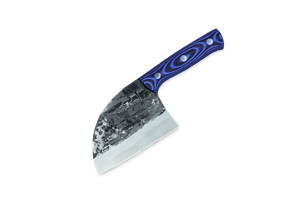
A Santoku is a Japanese-style multipurpose knife. Its name is commonly translated as “three virtues,” referring to its ability to handle vegetables, fish, and meat. Most Santoku blades measure about 5 to 7 inches. They have a broad blade, a relatively flat cutting edge, and a rounded or sheep’s-foot tip that drops low rather than rising to a sharp point.
A traditional Western chef knife is usually 8 inches long, though 6- and 10-inch versions are common. Its profile has more belly, meaning the edge curves upward toward a pointed tip. That curve is built for a rocking cut: the tip or front section stays close to the cutting board while the handle moves up and down.
Neither shape is a compromise. They are purpose-built answers to different cutting habits. The Santoku rewards clean push cuts, slicing, and chopping. The chef knife is a true workhorse when you want to rock through herbs, slice a large cabbage, portion proteins, or move through a long prep session without switching tools.
The Santoku profile
The flatter edge of a Santoku makes full contact with the board quickly. That is useful for diced onions, sliced mushrooms, julienned vegetables, and neat cuts through boneless proteins. Instead of rocking aggressively, you lift the blade and bring it straight down, or push it forward and down in a controlled slicing stroke.
Many Santoku knives also use a wide blade face. That extra height gives your knuckles room above the board and makes it easy to scoop prepared ingredients into a pan. Some feature hollow-edge indentations along the blade, which can reduce sticking when slicing moist foods such as potatoes, cucumbers, or salmon. They help, but they are not magic. Food release still depends on blade finish, slice thickness, and technique.
The shorter length can feel immediately manageable, especially if an 8-inch knife seems oversized. For cooks with smaller hands, limited counter space, or a preference for direct control, a Santoku often feels quick and exact rather than intimidating.
The chef knife profile
The longer, pointed blade of a chef knife creates more working range. You can slice through a large watermelon, halve a head of cabbage, or cut a long line of vegetables without running out of edge. The fine tip also offers more detail control for trimming, scoring, and working around small joints or stems.
Its curved belly is the deciding feature for many cooks. If you naturally rock your knife while mincing garlic, parsley, or basil, a chef knife feels fluid. A Santoku can mince herbs, but repeated rocking with a flat-edged blade may leave ingredients uncut at the edges or cause the blade to strike the board awkwardly.
A chef knife generally has more forward length and can feel more substantial in motion. That added presence is valuable when food is large, dense, or simply plentiful. It is not a cleaver, and it should never be used to cut through bones or frozen food, but it has the leverage and reach for demanding everyday prep.
Which knife performs better in real prep?
For vegetable-heavy cooking, the Santoku is often the faster, more comfortable choice. Its broad, flat blade excels at push-cutting carrots, celery, zucchini, peppers, and onions. The short length encourages a close, controlled grip, and the blade’s height makes it useful for transferring diced ingredients.
For herb work, a chef knife typically wins. The curved edge supports a natural rocking motion, while the longer blade gathers and chops a larger pile at once. If pesto, chimichurri, mirepoix, and finely minced aromatics are regular parts of your cooking, this is a meaningful advantage rather than a small design detail.
For meat and fish, either knife can perform well on boneless cuts. A Santoku delivers clean slices through chicken breast, pork tenderloin, and fish fillets, particularly when you use a draw or push stroke instead of forcing the blade straight down. A chef knife offers more length for larger roasts, wide steaks, and bigger portions of protein.
For oversized ingredients, the chef knife has the edge. A large squash, cabbage, pineapple, or melon benefits from blade length and a defined tip. Still, technique matters more than brute force. Stabilize the ingredient, use controlled cuts, and choose a smaller knife or a specialized blade when the task calls for it.
Control, comfort, and cutting style matter most
Blade shape matters, but the knife has to fit your hand. A well-designed Santoku can feel brutally efficient in a compact kitchen. A balanced chef knife can make a long Sunday prep session feel effortless. The better knife is the one you can guide precisely without gripping too hard or fighting the blade’s motion.
If you chop with an up-and-down action, favor a Santoku. If you rock the edge through ingredients, favor a chef knife. If you use both motions depending on the ingredient, a chef knife is more forgiving, while a Santoku may sharpen your push-cut technique and reward cleaner strokes.
Pay attention to blade weight as well. A lighter knife can reduce fatigue and increase agility. A heavier knife can feel planted and powerful through firm produce. There is no universal ideal. A knife that feels stable to one cook may feel slow to another.
Handle shape changes the equation, too. A rounded handle may suit cooks who shift their grip frequently. A more angular or contoured handle can lock the hand into a confident position for repetitive prep. Wherever possible, assess how the knife feels with a pinch grip, where thumb and index finger rest near the blade rather than entirely behind the handle.
Blade sharpness is more important than knife type
A dull chef knife will not outperform a sharp Santoku. A dull Santoku will not deliver the clean vegetable cuts that make the design so appealing. Sharpness determines how easily the blade enters food, how much pressure you need, and how likely ingredients are to split or slip.
Use a stable cutting board made from wood or quality plastic. Glass, stone, ceramic, and metal boards are hard on a fine edge. Wash the knife by hand, dry it promptly, and store it where the edge cannot knock against other tools. A magnetic holder, blade guard, or knife block protects both the knife and the person reaching for it.
For regular maintenance, use the sharpening method suited to the blade and its edge geometry. A honing rod realigns an edge but does not remove enough material to restore a truly dull knife. Sharpening stones or a quality sharpener are the right tools when cutting performance drops. Avoid pulling any sharp knife through an aggressive carbide sharpener repeatedly, as it can remove metal quickly and leave a rougher edge.
Should you own a Santoku, a chef knife, or both?
Choose a Santoku if your meals center on vegetables, boneless proteins, and precise daily prep. It is an excellent first high-quality knife for cooks who want a Japanese-inspired profile, a shorter blade, and direct control. It also makes a smart second knife for experienced cooks who already own a larger chef knife but want something faster for weekday meals.
Choose a chef knife if you want one blade to cover the broadest range of kitchen tasks. Its length, curved edge, and pointed tip make it especially versatile for large produce, herbs, proteins, and batch cooking. For many home kitchens, an 8-inch chef knife remains the most adaptable single-blade foundation.
Owning both is not excessive if you cook often. Use the Santoku when you want rapid vegetable prep and clean push cuts. Bring out the chef knife for rocking herbs, larger ingredients, and jobs that benefit from extra reach. Each earns its place by doing a different kind of work well.
The most useful test is simple: picture the last five dinners you made. If they involved lots of chopped vegetables and compact prep, a Santoku may become your favorite blade. If they involved large ingredients, herbs, and varied techniques, choose the chef knife that feels balanced and ready for serious work.


Leave a comment