

A tomato should not surrender to a dull blade. It should split cleanly beneath a controlled cut, with the skin intact until the edge says otherwise. That is the appeal of Japanese kitchen knives: not ornament, not ceremony, but precise cutting performance that changes the feel of everyday prep.
A well-chosen Japanese-style blade can make fast work of onions, herbs, boneless proteins, and delicate fish. But the category is not one single knife, and the wrong profile can be frustrating no matter how sharp it is. The real move is to match the blade to the work on your board, then give that edge the maintenance it deserves.
Why Japanese kitchen knives cut differently
Many Japanese kitchen knives are built around a thinner blade geometry than traditional heavy Western knives. Less material behind the edge means less resistance as the blade moves through food. Carrots crack less, herbs bruise less, and slices stay cleaner. That thin, precise feel is what people notice first.
The trade-off is simple: a finer edge asks for better technique. Do not twist the blade through dense squash, pry apart frozen food, or hammer through bones with a thin chef knife. A sharp knife is powerful, but it is not indestructible. Use the right tool and the edge will reward you with speed, control, and a finish that looks as good as it tastes.
Harder steels are also common in Japanese-inspired knives. They can support acute, ultra-sharp edges for longer than softer steel, but they may be less forgiving if mishandled. That is not a weakness. It is a design choice for cooks who want a blade that performs with intent.
Start with the blade profile, not the pattern
Damascus layers, hammered finishes, and dark forged surfaces have serious visual impact. They should not be the first decision. Start with the shape that fits your cooking, then choose the construction, steel, and handle that give the knife its character.
Gyuto or chef knife: the daily workhorse
The gyuto is the Japanese answer to the all-purpose chef knife. It has enough length for cabbage, roast chicken, and larger produce, while its pointed tip handles garlic, shallots, and detail work. For the cook who wants one capable blade for nearly every dinner, this is usually the strongest starting point.
A gyuto rewards a forward-and-back slicing motion rather than aggressive rocking. You can still rock gently through herbs, but the flatter edge profile is made to stay in contact with the board and move efficiently through ingredients. If your current knife feels thick, sluggish, or clumsy around the tip, a gyuto can feel like a serious upgrade.
Santoku: compact, fast, and vegetable-ready
The santoku is shorter, flatter, and often more approachable for home cooks who find an 8-inch chef knife too large. Its broad blade helps transfer chopped vegetables from board to pan, while the rounded tip makes it confident rather than intimidating.
This is a strong choice for weeknight prep: peppers, onions, mushrooms, boneless chicken, and piles of greens. It is less suited to carving a large roast or breaking down bulky ingredients where extra blade length gives you more authority. For a smaller kitchen or a cook who values quick control, the santoku earns its space.
Nakiri: clean cuts through vegetables
A nakiri is built for produce. Its rectangular blade and flat edge make full contact with the board, so onions, celery, zucchini, and cabbage can be cut in decisive vertical strokes without the annoying accordion effect of uncut strands.
It is not a substitute for every knife. The squared tip is not designed for intricate piercing work, and the blade should not be used on bones or frozen food. Yet for cooks who make vegetables the center of the meal, a nakiri can be more satisfying than a general-purpose blade. It is direct, efficient, and brutally good at its job.
Petty knife: precision where big blades get in the way
A petty knife typically sits between a paring knife and a chef knife in size. It handles fruit, small produce, trimming meat, slicing cheese, and detail work near the board. Think of it as the quick-draw blade of the kitchen.
A petty knife makes an excellent second purchase after a gyuto or santoku. It will not replace the power of a larger blade, but it takes over the small tasks that do not need eight inches of steel.
Yanagiba, deba, and cleavers: purpose-built power
Specialized Japanese profiles are worth buying when your cooking actually calls for them. A yanagiba is a long, single-bevel slicer for clean sashimi and sushi cuts. A deba is heavier and more substantial, intended for fish butchery and working around fish bones with controlled technique.
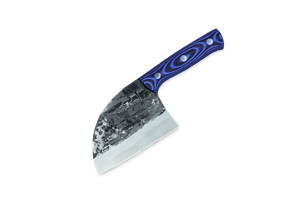
Then there are cleavers. A thin vegetable cleaver is not the same thing as a heavy meat cleaver, and neither should be treated as a general-purpose axe. A hand-forged, Serbian-style cleaver brings serious force to meat prep, dense produce, and outdoor cooking, while a lighter Chinese-style vegetable cleaver excels at slicing and scooping. Know the build before you swing it.
Steel and construction: choose your maintenance level
Stainless steel is the practical choice for most busy kitchens. It resists staining and corrosion, needs less vigilance after washing, and can still take a sharp working edge. A quality stainless workhorse is not a compromise. It is the blade you can reach for every day without turning cleanup into a ritual.
Carbon steel has a different kind of appeal. It can develop a fierce edge and a living patina that records its use over time. It also demands discipline. Wipe it dry during prep, wash and dry it immediately after use, and never leave it wet in the sink. If that sounds satisfying rather than inconvenient, carbon steel delivers raw character.
Damascus construction adds layered visual depth and can pair beautifully with a high-performance core steel. It does not automatically make a knife sharper. Edge geometry, heat treatment, steel quality, and sharpening matter more. Buy Damascus because you want a blade with craft written across its surface, not because the pattern alone promises performance.
Handle choice matters too. Wood offers warmth, grip, and classic workshop presence, but should not be soaked or put in the dishwasher. Synthetic handles generally tolerate hard daily use more easily. The best handle is the one that locks into your grip without forcing your wrist into an awkward position.
Keep the edge alive
A premium knife does not stay sharp by reputation. It stays sharp because it is used on the right surface and maintained with purpose. Use wood or quality plastic cutting boards. Glass, marble, ceramic plates, and countertop surfaces will wreck a fine edge fast.
Hand-wash your knives, dry them immediately, and store them where the edge cannot strike other metal. A magnetic holder, blade guard, or dedicated stand protects both the knife and your hands. The dishwasher is hostile territory: heat, detergent, moisture, and collisions are a bad combination for any serious blade.
Honing and sharpening are not the same job. Honing realigns a slightly rolled edge and is most useful on softer stainless knives. Sharpening removes metal to create a new edge. Whetstones offer the most control and are the right long-term answer for hard Japanese-style steel, though they demand practice. A guided sharpener can be more approachable for beginners, provided it is designed for the blade angle you use.
If the knife starts crushing tomato skin, skidding over onion layers, or requiring extra pressure, do not wait. Sharpen it before bad habits turn a clean cutting tool into a dangerous one.
Build a knife setup that matches your kitchen
Most home cooks do not need a block full of duplicate blades. A strong core setup is more useful: one gyuto or santoku for general prep, one petty knife for smaller tasks, and a bread knife if crusty loaves are part of the routine. Add a nakiri for vegetable-heavy cooking, a slicer for barbecue and roasts, or a fillet knife if fish is on the menu often.
For a gift, a compact set with a practical sharpening solution often beats an oversized collection. It gives the recipient tools they will actually use, plus a clear way to protect the investment. SAMURA builds this kind of knife ownership around performance blades, purpose-built profiles, and the maintenance gear that keeps them cutting hard.
The best Japanese kitchen knife is not the one that looks most expensive in a drawer. It is the one you reach for when dinner is moving fast, your board is full, and every cut needs to land clean.


Leave a comment