

A blade should earn its place on the cutting board. Damascus knives do that when their layered construction, sharp cutting core, and profile match the way you cook. The flowing pattern is striking, but this is not kitchen jewelry. A well-built Damascus blade is a hard-working tool for clean slices through tomatoes, confident work around dense vegetables, and controlled prep of meat and fish.
For cooks who are done fighting dull, anonymous knives, Damascus brings a stronger mix of performance and character. The key is knowing what you are buying, what the pattern actually means, and which blade shape will work hardest in your kitchen.
What Makes Damascus Knives Different?
Modern Damascus kitchen knives are usually made by layering different steels, forge-welding them together, then shaping the billet into a blade. After heat treatment and finishing, the surface is etched to reveal the contrasting waves, ripples, or raindrop-like lines created by those layers.
That visible pattern is real, not painted on. But it does not automatically tell you whether a knife is sharp, durable, or worth owning. The cutting performance comes primarily from the steel at the core, the heat treatment, the edge geometry, and the skill behind the grind. Layered cladding protects and supports that core while delivering the unmistakable Damascus look.
This distinction matters. A dramatic pattern can catch the eye, but a thin, well-ground blade with an ultra-sharp core is what makes an onion fall into neat slices instead of cracking apart. Look beyond decoration. Ask what steel forms the edge, how the knife is hardened, and whether the blade profile suits your prep.
The Real Benefits of a Damascus Blade
A quality Damascus knife gives you more than a good-looking surface. Its layered construction can pair a high-performance cutting core with more forgiving outer layers, creating a blade that feels refined without becoming precious. It should move through food with less resistance, hold a crisp edge, and give your hand dependable control.
The practical advantage shows up in repetitive prep. When you are mincing herbs, breaking down a chicken, slicing steak against the grain, or cutting a pile of root vegetables, a sharp blade reduces effort. Less force means better accuracy. Better accuracy means cleaner food, safer cutting, and a faster path from ingredient to pan.
Damascus also gives a kitchen tool personality. No two etched patterns look exactly the same, so the knife has an individual, workshop-made presence. For home cooks building a serious setup and gift buyers looking for something with real impact, that visual character is part of the value.
There is a trade-off. Premium steels that hold an edge for a long time can take more care to sharpen correctly than soft, basic stainless steel. That is not a drawback if you are willing to use a proper whetstone or sharpening system. It is simply part of owning a blade built to perform at a higher level.
Choose Damascus Knives by the Food You Prep
The right Damascus knife is rarely one knife for every job. Start with the ingredients you cut most often and the movements you naturally use.
A chef knife is the true workhorse for most kitchens. Its curved edge supports a rocking motion for herbs, garlic, onions, and broad vegetable prep, while its pointed tip handles finer work. If you want one powerful blade to upgrade daily cooking, this is usually the strongest first move.
A santoku is a more compact, flatter alternative with a fast up-and-down cutting style. It is excellent for vegetables, boneless proteins, and precise portioning. Cooks with smaller hands, limited board space, or a preference for controlled push cuts often find a santoku easier to command than a long chef knife.
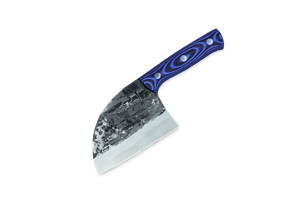
For meat-heavy cooking, choose based on the task. A slicing knife makes long, clean passes through roast beef, brisket, ham, and cooked poultry. A boning or fillet knife has the flexible precision needed to work close to bones and skin. A cleaver brings brute force and blade weight to larger cuts, but it should not replace a delicate slicer when presentation matters.
Bread needs a serrated blade, not a sharp straight edge forced through a crust. Fish preparation may call for a long yanagiba-style slicer or a sturdy deba-style blade, depending on whether you are making fine raw-fish slices or working through small bones. A specialized knife is not excess when it removes friction from a job you do repeatedly.
What to Check Before You Buy
A Damascus finish alone is not a buying standard. Construction and fit determine whether a knife becomes your favorite tool or stays parked in a block.
First, examine the core steel and its hardness. A harder steel generally supports finer edge retention, meaning fewer full sharpening sessions. Extremely hard steel can be less tolerant of twisting, prying, or striking hard bone, so use the knife for cutting, not as a lever.
Next, consider blade geometry. A thin edge gives outstanding slicing performance but demands a proper cutting surface and disciplined technique. Avoid glass, marble, ceramic, and metal boards. End-grain or quality wood boards are easiest on an edge, while a good plastic board is a practical everyday option.
Handle shape matters as much as blade material. The knife should sit securely in a pinch grip, with no hot spots where your thumb and forefinger naturally rest. Wood brings warmth and a traditional feel but may need occasional conditioning. Modern composite and synthetic handles are often easier to maintain, especially in busy kitchens.
Finally, think about length. An 8-inch chef knife is the daily sweet spot for many cooks. A 6-inch blade offers nimble control in smaller kitchens, while a 10-inch knife gives greater reach for large produce, big proteins, and high-volume prep. Bigger is not automatically better. A knife you can control confidently is the knife you will use well.
Care That Protects the Pattern and the Edge
Damascus steel deserves basic discipline, not ceremony. Hand-wash the knife with mild soap, rinse it promptly, and dry it completely. Never leave it soaking in a sink or send it through a dishwasher. High heat, aggressive detergent, and loose contact with other utensils are a fast route to dull edges and damaged handles.
Store the blade where it cannot knock against metal. A magnetic holder, blade guard, or dedicated stand protects the edge and keeps the knife ready for action. Tossing a premium blade into a drawer is a rough end for any sharp tool.
Use a honing rod only when it suits the knife and your technique. Honing realigns a slightly rolled edge; it does not replace sharpening. When the knife stops biting cleanly into a tomato or begins slipping on onion skin, sharpen it with a whetstone or a quality sharpener designed for the blade. Slow, controlled passes beat aggressive grinding every time.
If your Damascus knife uses a high-carbon core or carbon-rich steel, keep it especially dry and clean after acidic foods. A little discoloration can develop over time and is often part of the blade's working character. Rust is different. Prevent it with prompt cleaning, thorough drying, and occasional food-safe mineral oil when appropriate.
Pattern Is Character, Performance Is the Point
There are plenty of knives that wear a Damascus-style pattern. The ones worth keeping combine that visual force with honest materials, a precise edge, and a shape built for actual food. That is the standard to bring to any collection, whether you want a versatile chef knife, a hard-charging cleaver, or a dedicated slicing blade for the grill.
At SAMURA, the strongest knife choice is not the loudest pattern or the biggest blade. It is the one that makes your most common kitchen work feel cleaner, faster, and more controlled. Put it on a proper board, keep the edge maintained, and let it build its character one serious meal at a time.


Leave a comment